 Changelly exchange
Exchange is a Cryptocurrency Conversion Service for Changelly Users
Exchange is a Changelly crypto-swap workflow in which a quote links one input asset and network to one payout asset, network and wallet address. The route starts after the user confirms the amount, recipient details and rate type, then sends the deposit to a single-use pay-in address. Changelly tracks the deposit through confirmation, conversion and payout states before publishing a payout hash. Sound operation therefore means preserving the order ID, matching the network as well as the ticker and comparing the received amount with the confirmed order details. If progress stops, those records separate a network delay from a routing problem and give support the data needed to push, refund or explain the transaction.
It is a Changelly crypto-swap workflow that routes a quoted asset pair for wallet users who can verify the network, payout amount, status, and refund address.
Network Matching Determines Whether the Payout Arrives
Network matching determines whether a Changelly payout reaches an address the receiving wallet recognizes, because a ticker alone doesn't identify the blockchain carrying the asset.
USDT illustrates the constraint. The token exists as ERC-20 on Ethereum and TRC-20 on TRON, yet those networks use different transaction formats and fee assets. An Ethereum-style address can also represent accounts on multiple EVM networks. Ethereum mainnet uses chain ID 1, BNB Smart Chain uses 56 and Base uses 8453. Because all three accept the same 20-byte account form, a syntactically valid address doesn't prove the wallet is watching the quoted chain.
Compare the protocol label on the quote with the wallet's receive screen before confirming. An EVM address carries 40 hexadecimal characters after 0x, making 42 characters in total; a common TRON Base58Check address carries 34 characters and starts with T. Format checking catches some errors, but only network selection resolves EVM ambiguity. Kraken deposits use the same network-matching rule, while Exchange adds a second check for the payout network.
Which Quote Inputs Control the Route?
Changelly quote routing uses the input asset, input network, output asset, output network, amount, rate type, recipient details and a fixed order's refund address.
Changelly queries its trading partners and presents an executable offer from those inputs. The service controls provider selection; the user accepts a quote rather than picking an order book or liquidity pool. By comparison, 1inch shows an on-chain route across decentralized sources and Uniswap executes against smart-contract liquidity. The wallet signs the Changelly pay-in transfer, then receives a separate payout transaction. That workflow relies on a pay-in, an external conversion and an outbound transfer.
Rate type changes how quickly funding must arrive. A Changelly fixed-rate pay-in address remains active for 15 minutes, or 20 minutes for BTC, XMR, LTC, DCR, EOS, GAS, BNB and VET, while a floating-rate address remains active for 3 hours. Each address is non-reusable, so generating another quote also means using another address.
For an API-backed wallet, a fixed order carries 1 rate ID and uses JSON-RPC 2.0. The request supplies either amountFrom or amountTo, never both. Changelly returns one order ID, one pay-in address and the pay-till timestamp. Keep that timestamp beside the wallet broadcast record; it decides whether the deposit entered the quoted window.
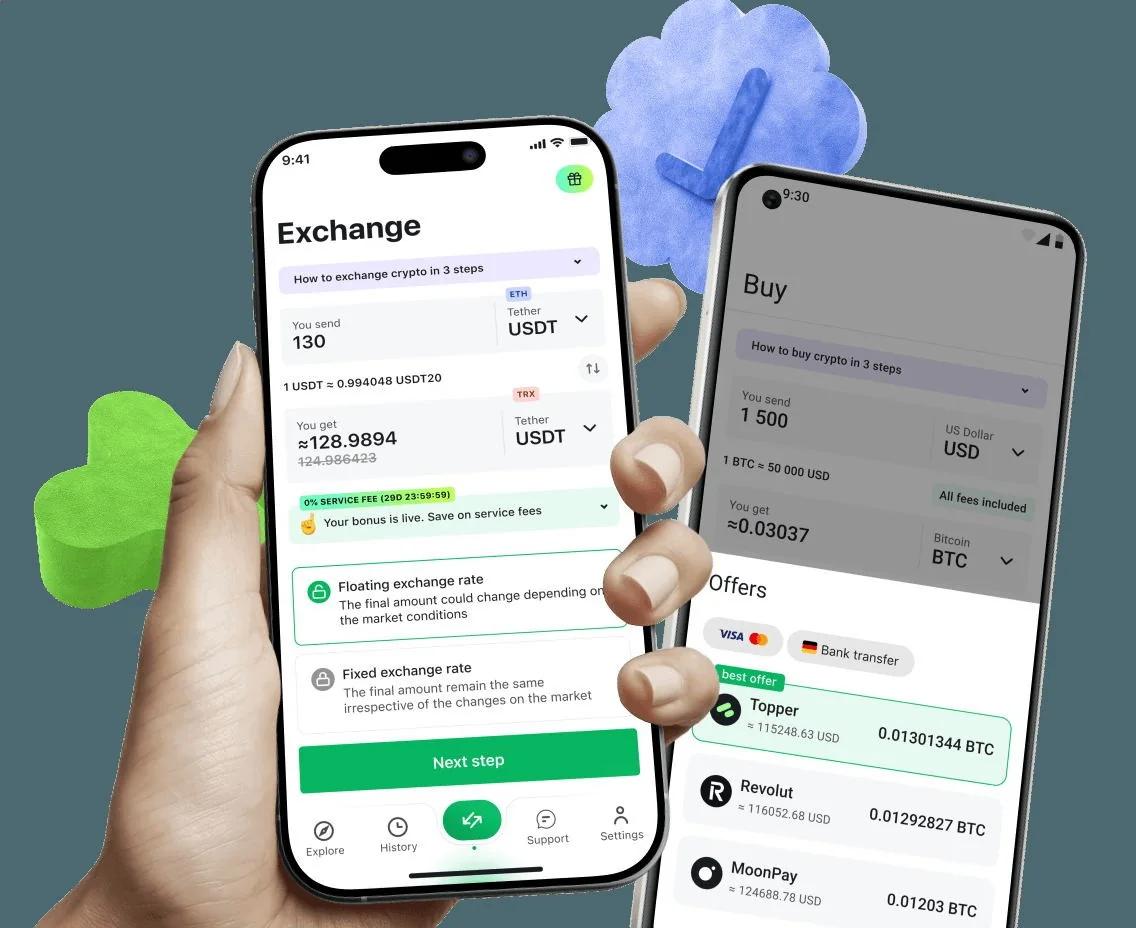
Four Stages Turn a Quote Into a Wallet Payout
An operational view groups the Exchange lifecycle into four stages, each leaving different evidence for verification or recovery.
Quote approval produces the service record. The wallet then creates an incoming blockchain transaction. Changelly waits for the required confirmations, performs the conversion and broadcasts the payout. This stage map keeps those layers separate.
| Stage | Observable Evidence | Standard Count or Duration |
|---|---|---|
| Quote Approval | Pair, networks, amount, rate type and address details | 1 order ID |
| Pay-In Broadcast | Wallet record and pay-in hash | 1 incoming transaction |
| Confirmation and Conversion | Confirming followed by exchanging | 2 sequential states |
| Payout and Verification | Sending, finished and payout hash | 2 final states and 1 hash |
The Changelly transaction ID identifies the service order; it isn't a blockchain hash. A complete successful swap creates two chain records: one pay-in hash and one payout hash. Bitcoin transaction IDs represent 32-byte hashes and normally display as 64 hexadecimal characters. EVM hashes also contain 32 bytes, but the 0x prefix brings the displayed form to 66 characters. Use the order ID for route status and the two hashes for ledger verification.
How Do You Confirm the Wallet Before Sending?
Wallet confirmation matches the quote to an address you control, the correct network and every extra routing field the receiving platform supplies.
A fixed-rate order also needs a refund address for the input asset. Treat recipient and refund details as separate destinations: the first receives the output and the second receives a recoverable input balance if execution fails. XRP Ledger destination tags use 32-bit unsigned integers, while Stellar supports a text memo up to 28 bytes and hash-based memos of 32 bytes. When Changelly shows an extra ID, copy it with the address on both pay-in and payout sides. MetaMask and Trust Wallet make the active EVM network visible, so compare that name before copying the address.
Status Codes Separate Network Delay From Route Delay
Changelly status codes separate the incoming blockchain leg, the conversion route and the outgoing payout, so each delay points to a different record.
A related page goes further into Using Changelly exchange. Changelly's API exposes 10 retrieved status values: waiting, confirming, exchanging, sending, finished, failed, refunded, hold, overdue and expired.
Waiting means no pay-in has appeared. Confirming means the deposit exists but lacks the required chain depth. Exchanging moves the case to Changelly's trading route, while sending means the payout process has started. Finished means Changelly sent the coins. Failed, refunded, hold, overdue and expired describe separate exception paths, so don't treat every non-finished order as the same problem.
Network timing supplies context, not a Changelly deadline. Bitcoin targets a 10-minute block interval. Ethereum uses 12-second slots and 32 slots form one 6.4-minute epoch, although an empty slot produces no block. Changelly sets confirmation depth per incoming currency, so one visible confirmation doesn't promise route progression. Zero confirmations keeps the order at the network layer; exchanging or sending moves it beyond that layer.
Once a payout hash appears, open the receiving chain's explorer and compare the destination and asset. The order view answers route state; the explorer answers ledger state, which is detailed in Changelly exchange overview.
What Evidence Makes a Recovery Request Actionable?
An actionable recovery request connects the Changelly order to both chain legs, the intended wallet details and the exact state where progress stopped.
- Record the Changelly order ID and displayed status.
- Save the pay-in hash, network and confirmation count.
- State the input ticker, selected protocol and amount actually sent.
- Include the payout address, refund address and any extra IDs.
- Add the payout or refund hash when either one exists.
Recovery options follow the latest state. An unfunded order can expire without a transfer. A failed fixed-rate order with a valid refund address has a published refund path of up to 1 hour. Reuse of a same-currency pay-in address moves handling outside automation and commonly carries a 1-2 business-day resolution window; a missing memo or destination tag can extend handling to 7 business days. A wrong-network transfer has no standard ETA because access and recovery support differ by chain and address type.
Support decides whether an interrupted order exposes a push or refund option. A push resumes conversion under the available execution terms, while a refund sends recoverable input assets to the recorded refund address. Choose between those outcomes only after matching the actual deposit amount and network.
Payout Verification Closes the Recovery Window
Payout verification closes the Exchange workflow only when the outgoing hash shows the expected asset at the confirmed recipient on the selected network.
Finished status and a payout hash establish that Changelly broadcast the outbound transfer, but the wallet interface still needs to index the correct asset. For ERC-20 tokens, inspect the token contract and Transfer event on an Ethereum-compatible explorer. A native ETH payout appears as a balance change instead. Solana uses 32-byte account addresses, while TRON represents common wallet addresses as 34-character Base58Check strings. These structural checks reveal whether the wallet display is lagging or the payout belongs to another network.
After the destination chain confirms the payout, Changelly can't reverse it. If the same private key controls the matching address on an EVM network, switching MetaMask or Trust Wallet to that chain may reveal the balance.
Custodial destinations and omitted tags require the receiving service to reconcile the credit. Coinbase keeps trades inside an account until withdrawal, while Changelly completes its route with an external wallet payout.
Frequently asked questions
Does a fixed-rate Changelly order include the payout network fee?
A fixed-rate Changelly order locks conversion terms while leaving the payout network fee as a separate order component. In API records, amountExpectedTo represents the expected payout before networkFee is withheld, while amountTo records the amount sent after processing. Read the confirmed transaction details instead of subtracting a generic percentage, because the route and payout chain determine the displayed components.
Why can a deposit below the displayed minimum stop processing?
A deposit below Changelly's displayed minimum can't enter the selected exchange route automatically. The minimum shown at quote time reflects the pair, input network, payout network and available execution path. If the deposited balance also fails to cover an input-chain refund transaction, recovery becomes constrained by the network fee. Send the exact instructed amount after checking the active quote.
Can I split one Changelly deposit across two wallet transactions?
One Changelly order should receive one wallet transfer for the exact instructed amount. The order tracks a pay-in hash and doesn't reliably merge separate deposits into a single automatic route. Multiple payments can therefore leave one transfer unmatched or move the case into manual handling. Create a separate order for each transfer unless the transaction interface explicitly supplies different instructions.
Is an account required to track a swap started inside a wallet?
A Changelly account isn't always required, but the transaction ID remains essential for tracking an embedded-wallet swap. The wallet interface or its exchange partner should display the provider, order status and service identifier. Save those details before leaving the flow. If the order enters hold or fails, the wallet's own transaction hash alone won't identify the corresponding Changelly route.
Which asset does Changelly use for a fixed-order refund?
A fixed-order refund returns the input asset to a compatible refund address. The refund address must match the currency and network used for the deposit, and any required memo or extra ID must also match. Changelly doesn't convert the refund into the intended payout asset. The returned amount reflects recoverability and the network cost of broadcasting the refund transaction.
What happens if a swap enters hold after the pay-in confirms?
A hold pauses the Changelly route for a compliance review after the service associates the deposit with the order. Contact Changelly support or follow the instructions presented by the wallet partner, then provide the Changelly transaction ID and requested verification records. The pay-in hash proves the blockchain transfer, but it doesn't replace the service ID used to review and release the order.
Do I need native gas in the receiving wallet before the payout arrives?
You don't need native gas merely to receive a standard token payout at a valid self-custody address. You'll need the network's native asset when you later send or interact with that token. Moving ERC-20 USDT requires ETH, moving TRC-20 USDT requires TRX and moving a BEP-20 token requires BNB. The quoted payout network decides which gas asset applies.